
A Big (molecular) Deal

Is communicating your key strategic message done at the molecular level?

This custom 3D exhibit model molecule, created for a pharma group, is making their discussions with physicians even more dynamic. The company wanted an addition to printed materials and animations for their trade show booth to really engage physicians and start conversations about their new drug.

About the size of a soccer ball and terrifically sparkly, the model is visually striking with an inviting physical experience. 3D exhibit models are eye-catching, attention grabbing & definitely draw a crowd.

Molecule_TS_AssyMolecule_TS_Detail-2Molecule_TS_Half


Contact Pulse Medical Demonstration Models

Call today and fill out a project questionnaire so we can begin sketching your exhibit model. Our team will work with you to produce a dynamic hands-on experience for physicians.

laparoscopic-trainer-pelvic-health-Pulse-MDM

Multi-Sensory Training For Physicians

“Multi-sensory training protocols, as opposed to unisensory protocols, can better approximate natural settings and, therefore, produce greater and more efficient learning.” Shams & Seitz, University of California

If you are inviting a surgeon to train using your device or if you have an opportunity to demonstrate your procedure, you could be adding ‘touch’ to your visual & auditory content and have a greater impact on understanding, retention, and recall.

A custom 3D medical demonstration model can be complex realistic anatomy or pared down to the specific anatomical feature that you need to communicate the merits of your approach. Models are designed to be congruent with your marketing and crafted to be easy to carry, stow, set up, use, and refresh.

And every time you let a physician get hands-on practice, we know you will reinforce key strategic messages, greatly emphasize differentiators, make your brand much more engaging & compelling, and dramatically boost adoption.

Contact Us

Call Pulse Medical Demonstration Models for a consultation. Once we understand your needs, we will begin sketching model concepts for you to review.

Uterine-Model-Prolapsed-with-Cervix-PULSE-MDM

How will you demonstrate your device?

You may have an inkling, just a wisp of an idea, of how you would like to demonstrate your medical device & procedure. Custom 3D models can be crafted to support your Physician Education, Sales, Marketing, and Training efforts in addition to or even taking the place of videos, animations, virtual instruction, and labs.

When we understand what you are trying to accomplish, sketches are created to highlight key messages and your differentiators. Working with your team the model design is edited & augmented to meet your criteria.

As the models are produced, we get your input on things like material choices, size,  scale, and shape. Very different from acquiring a stock model where you would be trying to decide; “Which one is closest to what we need?”  Your model will be engineered to deliver a specific experience, showing the merits of your device, and telling the story of your brand.Making a model that is totally congruent with your marketing is a requirement. And it is fantastic when we get to include the experience & preferences from all the groups who will be using the model.

Contact Pulse MDM today!

Let us send you a Pulse Medical Demonstration Models Project Questionnaire as a starting point to creating a gorgeous, eye-catching, engaging, compelling, and memorable model.


Remember: When you add touch to your verbal and auditory content, you dramatically boost comprehension, retention, and recall.


Calyceal-mold-for-kidney-stone

Kidney-Shaped Training

“It was my arm standing in as the C-arm, my cell phone as the fluoroscope, an iPad and a block of silicone… that was our first training model.”

Jerry Long, Director of International Marketing at Boston Scientific had a challenge; “How could we as a company and as an industry impact the number of endourology procedures globally and especially in emerging markets?”

Jerry and his team, with the Society of Endourology,  convened with leaders in urology to find some possible solutions. They were well aware that the three barriers would be: Training, Capital Equipment, and Reimbursement – which is especially tricky in some regions. The group decided to focus their efforts on training. They saw training as the activity most likely to launch – and predicted it as the most direct strategy to get physicians to do more procedures.

Supported by BSCI leadership, The Stone Institute was established to develop an integrated training program that could be taken around the world.

Like most new endeavors they began with limited resources to see if their idea was workable and eventually scalable. Would they be able to attract physicians? Could it be replicated internationally? How would it affect surgeon perspectives for treatment? And would the program find support with partners in the field?

The objective was to create a consistent high-quality training program combining didactic and hands-on instruction to improve key surgical & procedural skills advancing the level of expertise for Stone Disease globally.

The expectation was to grow the volume of procedures performed worldwide with the overall intention of improving patient health.

At the completion of the initial training programs, evaluating the first participant feedback, and with Jerry’s arm quickly wearing out, the team began planning improvements for the next round of training. A second-generation training model involved hacksawing off the back of an old office chair to get the required ‘C-shape’ for the C-arm and creating a rough SLA or 3D printed kidney. Additional training programs garnered more and better feedback on both the classroom training and the hands-on surgical lab.

The next stop was the Boston Scientific model shop where the first of many portable, radiation free, C-arm designs was crafted and operable calyceal molds were cast.

More training, more feedback, and required improvements were made.

They now had enough information to have Pulse Medical Demonstration Models create & produce in quantity, beautiful & branded 8th generation models: realistic mini C-arms and surgical practice kidney calyces that provided a very real-life surgical experience, designed to be totally congruent with The Stone Institute.

In the 18 months since The Stone Institute was established, 630 physicians have been trained globally in the surgical skills for flexible ureteroscopy and percutaneous nephrolithotomy (PNL).


  • The innovative lab design has enabled a realistic and radiation-free environment for practicing surgical techniques
  • The novel clear silicon kidney model offers true-to-life needle puncture pressure and feeling
  • And the custom camera and software replicates fluoroscopy images on a screen
  • At each selected training site a core faculty member has been paired with a ‘local’ faculty member for training delivered at a hospital or conference center. The pairing integrates each program culturally, raising visibility and building trust.


The Results!

  • Post program surveys have found that surgeons doubled their confidence level in the key skills
  • Procedure volumes have increased overall, achieving the goal of improving patient health


Using direct and specific surgeon feedback The Stone Institute has been able to create the most captivating & compelling, practical & portable, striking & memorable experience possible. In addition to sites like South Africa, Brazil, Poland, Dubai, China, and Singapore – ongoing programs will continue to be offered around the globe.

“It’s scary to go out to the customer with something ugly or something that you don’t know is going to work. But it is wonderful to engage physicians in a way that gets them to jump on board and partner with you. The physicians every step of the way have been enthusiastic critics to improve the overall experience for the next group of trainees.” – Jerry Long, The Stone Institute


Contact Us

Let’s talk about your medical device, procedure, or drug delivery method and see how we can tell your story in a high-touch, hands-on, engaging & experiential, visually striking, compelling & most memorable way.


Lung-Biopsy-model-with-pleural-linings-and-pleural-space

Let’s Get Physical

We know that multi-sensory experiences promote comprehension, retention, & recall.

Presenting & training using a 3D model adds touch with the visual & auditory content, boosting engagement with your audience, intensifying the impact you make with your potential customers, making your medical device even more memorable.


We asked Speaker Skills Coach Greg Brower for his advice in helping the trainer & presenter to connect to their audience. Here are a few tips on how to use a model to best effect.


The client is your focus. This is in every sense. Your presentation should take into account your client’s expectations, challenges and needs. It should definitely be designed to address the application, effect on patient care, as well as the impact on both time & money. But you will also need to make sure that you look at and engage the physicians directly. Pay attention to your audience; don’t save your eye contact for your model.


Tell a good story. A list of features or a data dump is not interesting nor is it memorable, so start with a story. A good story provides the context and will make your demonstration relatable, relevant, & noteworthy. The story may contain those key features and valuable data, but more importantly it will give you a narrative on which to build.


Break it down. Just like the digestive tract you have to break it down for it to be digestible. People can’t remember 10 or 20 steps. By breaking the information & instruction into smaller chunks you will boost retention.


Good Timing. Do find out how much time you will have with your prospective customers. You should budget 1/3 of your time for your presentation/demonstration and 2/3rds for hands-on practice & feedback.


Which brings us to Practice. (This is our favorite part!) Practice is vital to take the application of your device from theory to reality. When you give physicians practice using your device not only will you make your brand unforgettable (unforgettable!)you will help them achieve mastery using your device. Practice also gives physicians the opportunity to discuss with their peers. Some of the most interesting discoveries (your product’s key features) or arguments (your product’s competitive differentiators) may come out during those discussions. It adds credibility to learn about product features from a peer and if there is a Key Opinion Leader in the bunch it will powerfully reinforce your message.


One more thing. When presenting with a device or model that is small enough to hold in your hand…try holding it in your left hand. In cultures where people ‘read’ from left to right – they will look at you while you are talking then look at your device and then do it again. It’s a brain thing.


Are you ready to imagine demonstrating your device in a much more compelling manner?

Let’s meet or speak. Once we understand your device, your procedure, and your key strategic messages, we will sketch some model concepts of what your model could look like. Or if you are currently using a model that is not quite meeting your needs, let us take a crack at it. We are likely to come up with a surprising solution. We are clever like that.


If you would like a fantastic trainer, coach, facilitator to work with your group, Greg Brower has helped thousands of speakers & presenters differentiate themselves from the competition. [email protected]

Exhibit 3D Model

Medical Device + Model = powerfully distinguish your brand

Imagine being a Medical Device Engineer and you’ve got, let’s say, some sort of catheter. You’ve just had a really novel idea around how it moves through the vascular system. In order to test how it steers & progresses through the vessel, you have cobbled together an initial model that’s made from paper towel tubes, duct tape and coffee stirrers — the very first germ of a model. As you jiggle and twist it about, you are probably wishing that you had the vessels of a right arm that you could pull out of your desk drawer … just to play around with.


We wish you did, too.


Our Med Device clients have actually shown us the FedEx boxes, plumbing parts and fishing gear that they are using. Oh, and apparently fruits & vegetables are in widespread use, too. In fact, beets are very popular. It truly is fantastic (& occasionally hilarious) when a client shows us what they have been using as a model. Because it means we don’t have to convince them about the merits of models. It shows us that they are already half-way there.


The headwinds that face the medical device industry are pretty strong right now in terms of longer, more intensive, more expensive regulatory timeframes. It’s extremely important for early-stage startups and teams working on new devices to ensure that their idea for a device is viable. Prototypes & medical device models regularly come into play in terms of generating interest and exposing a potential idea to the marketplace. So, we’re advocating — practically agitating — that everyone “Think Models” throughout the development cycle of a device. We want to sway you to turn to a model much earlier in the creative process when all you have is simply an idea – with the hopes of helping you get others to jump on board, acquire financing, and gain champions. Of course, much, much later in the process, we want models to also help support all chances to offer hands-on practice with your device, at every opportunity and in every setting.


Let’s start with models that can be used before you reveal your ideas even to your own associates, before you share your ideas within your own team.


You’re thinking of and practicing a new way to extract a stone from a kidney. You have thought through only a quadrant of the idea. It’s an inkling of how it would work, and what that might look like. If you had a model on your table, you would do some tests on the design. You could try your first seed of an idea. Take a first swipe to see — is this even a little bit worthwhile? You would be able to answer your initial question of. “Is this something I want to pursue?”


In using a model the moment an inspiration first hits you, you will immediately discover all sorts of things — uncover faulty assumptions, gain confidence in other areas, change-up some of your original thoughts, and grow your idea into something that you then could bring to others.


“Every time you make a prototype, you learn something. And so the more prototypes you create, try and test, you veritably juice the development cycle.” —Allison Rae


Yes. Juice. Maybe even beet juice.


There will be a point, early on with your prototype, that you will be tempted — or even eager — to go to an animal. But the requirements are stringent. You will have to have something that you can justify to your internal review board – demonstrating that it’s worth going into the lab. With a model, instead of dramatic learning (success or failure) in an animal or a cadaver, you can let some of those weaker ideas fall away. You will cast aside some of your non-workable ideas, discard approaches early and quickly — and likely in the confidence of your own team. And you will find your ultimate direction through each early failure.


Another challenge to the hurdles of taking an idea into the lab is the inconsistency of the animals. The processes to make a prototype model are going to yield the exact same model every single time, whereas if you have eight different animals, then you’re going to get different feedback. The properties will be different on each animal, and it could cause unwanted variables. Eventually you have to address that, but early on you’re trying to eliminate ideas. Using models makes it easier to iterate quickly. You can repeat earlier, less expensively, and definitely with way less paper work. For an accelerated development cycle, models make each try quicker.


Certainly, R&D people understand the merits of using models because they are by nature creative in trying to find solutions. As we said earlier, Pulse sees R&D clients cobbling up their own fixtures or using industrial parts in the place of body parts. But making anatomical models is not what they’re charged to do. What they are charged to do is design the device, and making models becomes a distraction from the main program.


What training and clinical teams are charged to do is educate the physician. Making a model or finding a model also can be a distraction to them. Knowing that models are so very valuable in R&D, you may also consider that you are underusing medical device models in terms of professional education.


A few years ago, members of a Med Device team were kind enough to invite us to one of their training sessions for surgeons. It was a lecture from their physician, and then a porcine lab demonstrating their approach. Labs can be big, cumbersome programs when you consider everything that goes into them: choosing a location and date that does not conflict with other programs, your staff members’ time & commitment to the program, inviting and flying in the surgeons, setting up the lab, navigating through that facility’s or that country’s requirements. The time and dollars involved can make it extremely inconvenient and costly. Obviously, the benefit is that it’s real tissue and a live or life-like situation.


We asked that Med Device team after the lab: “What would you need in order to reduce or to stop doing the porcine labs completely?” Their response: “A way to teach and allow practice, placing and fastening our device in life-like tissue, giving every surgeon a fresh try.”


What we created were portable, insufflatable, laparoscopic trainers with consumable, replaceable, abdominal plates that are actually engineered to accept a large trocar without the model losing pressure. We used the client’s company ports on the sides of the models, and we created non-medical grade scopes that are USB-compatible, so no need for any technology except a laptop. Now their teams take the models to any lab, hospital OR or doctor’s office — even hotel ballrooms.  Different than a lab, they have no restrictions culturally anywhere in the world. Unlike a porcine model, it can be stored in a closet, put in the “boot” of a car, and checked as luggage. And the surgeons who are prospective clients are getting hands-on practice with their device & procedure before they are in a surgical setting.


The clinical & training teams found that it multiplied opportunities to engage surgeons in critical conversations.


More chances for critical in-depth conversations are what all of our sales and marketing teams also want.


One client told us; “I always leave physician training courses thinking, ‘I wish I could take that model with me.’ If I could use that model in the field, if surgeons that I meet with could try it, my sales would definitely increase if not go through the roof, because it’s not only a clear way to differentiate my particular device from the competition but it would be a great way to add value from the physician’s perspective.”


And we said; “Exactly!” We are absolutely driven to provide Med Device teams with models to demonstrate their devices. And not every model has to be a complex, realistic anatomical copy.


Some models can be a small slice of the anatomy, only the targeted location for the procedure. When what differentiates the device is not the full procedure, the model can be focused on just the organ or vessel or tract that you need to highlight for your competitive strength. As an example: If the surgeon already knows how to go through the chest wall, and the chest wall is not the focus of your deployment, then the chest wall does not need to be part of the model in order to underscore your key strategic message. By paring down the model to the absolute essence of what you need to show, the model is smaller and more lightweight, takes less materials so is less expensive, and can be designed to be easy to set up, use and reuse.


Giving each salesperson a model that’s designed precisely and engineered intentionally to deliver a very specific experience using your device, dramatically lengthens and deepens the conversation with the physician. And we know that when you add touch to your visual and auditory content, you boost comprehension and recall. Surgeons will be intrigued by the experience and fully engaged with your product.


Occasionally, a model can be designed to be sent directly to physicians, literally giving them an experience right at their fingertips.


Client Quote: “The model has accomplished what we had hoped and more. It has helped us to gain a competitive advantage in the realm of safety for patients. Clearly, when patients are exposed to the model, they pick out our soft silicone piece in comparison to the large metal coil every time.”


This model project was for a permanent contraceptive device. Our client was introducing a product that’s a foamed silicone implant about the size of a grain of rice. With bipolar energy to disrupt the surface of the fallopian tube, the soft-foamed silicone is implanted, the tissue grows into it and it’s comfortable & inert. The competitor was making a large coil spring, maybe an inch long, sharp on both sides, and made of metal.


When our client posed the scenario to us, we came up with a number of concepts of how to tell that story with a model — allowing the physician, and eventually the patient, to come to their own conclusion.


The model that was created has a replica of the competitor’s device in the right fallopian tube, and in the left fallopian tube there’s a replica of our client’s device. The model has a lid you can take off and feel the softness of the silicone implant and feel the hard metal of the other. But even just looking at it you can see that there is no way anyone would choose the metal coil over the foamed silicone implant. The exciting part was 13,000 models were sent directly to their targeted surgeons, achieving potential market coverage overnight.


The process of learning is different for everyone. There is usually that period of frustration where you don’t get it, don’t understand it. Then, there is the leap – “Even though I understand it intellectually, actually doing it is proving challenging.” Then, it’s putting it aside. And then finally, “I am really good at this, I want to show it off!” We have clients that tell us about standing-room-only labs where the physicians are absolutely salivating to get a chance to do the procedure and on the other end training classes where physicians are hesitant to try the actual hands-on component because they are around their peers. We have device developers who are frustrated in telling their story to non-medical people because they don’t have a way to make it come alive for their audiences. We know physician educators who understand the power of hands-on experience, but don’t have the ability to put the device in every single surgeon’s hands. And we know that you have a million salespeople who want more and better ways to engage their clients.


If there is one thing we know without a doubt it is: When you match your medical device to a model, demonstrating your product’s advantages while giving surgeons hands-on experience — you powerfully distinguish your brand.
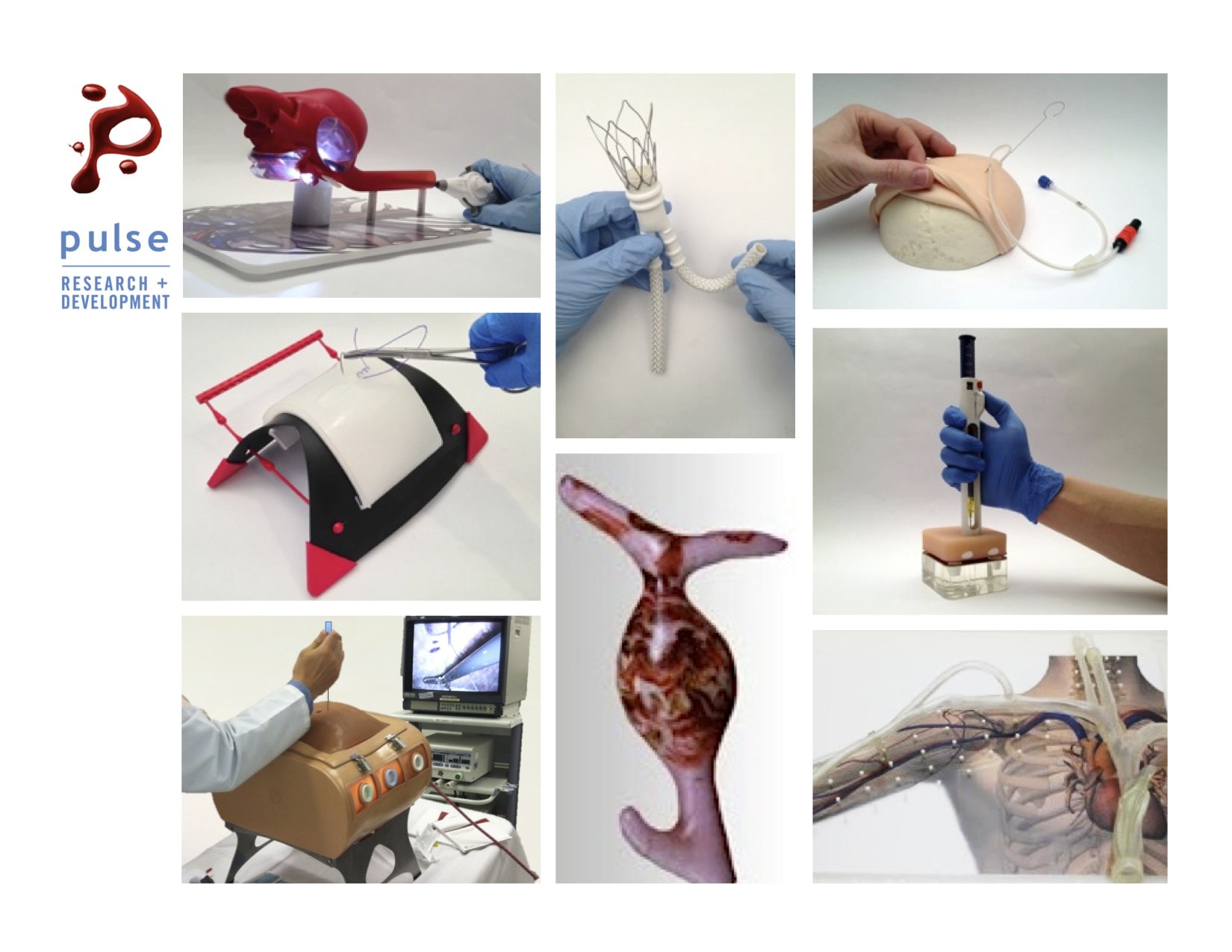
Pulse montage #1 copy

medical device training | pulsemdm

Your Medical Device in Surgeon’s Hands

You can best engage surgeons by giving them a fresh try with your device. Offering them a chance play with it, getting a feel for how it deploys and observing it in situ. If the demonstration model is intentionally engineered to show the merits of your specific device if it is intuitively designed with smartly crafted consumables, and if it is created to be easily carried, stored, & refreshed, then your team in the field will not hesitate to use it.


Contact Us

Call Pulse Medical Demonstration Models for information about custom 3D models. Pulse MDM creates clinically realistic custom medical models for your needs.


Demonstration heart with consumable replaceable septum for realistic feel.
Surgeons can practice stone removal using faux fluoroscopy with a custom C-Arm and realistic feel & view calyceal system


Eye Model - Pulse MDM

When method of drug delivery = medical device + pharma

When the method of drug delivery is part of the story you are trying to tell, a custom 3D model will elevate your presentation to internal review boards & investors while making training to clinicians, physicians, & patients even more engaging and dynamic. Show the action of drug delivery in a way that makes your approach unforgettable!

Models can be designed for:

  • Injection, micro-injection
  • Infusion, inhalants, ingestibles
  • Bioresorbable, drug-eluting devices
  • Allograft, allogeneic transplant, homograft
  • Implantables, stents, scaffolds, balloons, transdermal patch


Contact Us

Let’s set up a phone call or you can invite us to your office. We will forward you a project questionnaire and ask for links to your brand, photos of your medical device, and videos of your procedure. Pulse Medical Demonstration Models will help make your presentations unforgettable.

Custom Model | Pulse Medical Demonstration Models
Show your method of drug delivery with a portable custom model.